

What type of sales training is right for your team?

What type of sales training is right for your team?
The World Economic Forum predicts that 59% of the global workforce will need to upskill by 2030 due to the accelerating technological advancements. Sales training programs give your company a competitive advantage, attracting top talent while improving your current team’s skill set.
However, you need an effective training program to see results. To find one, you must consider certain factors, such as program customization, flexible methodologies, behavioral focus and post-training reinforcement methods. Creating a training program from scratch can be ineffective compared to opting for a proven and trusted program. Janek Performance Group breaks down everything you need to know to help you find the optimal sales training platform.
Key Takeaways
In a nutshell, the ideal training program for your team:
- Is customizable to your company’s goals and industry.
- Incorporates flexible, proven sales methodologies.
- Focuses on long-term, behavioral change rather than pure content delivery.
- Comes with leadership and internal team buy-in.
- Is available in different modes of delivery.
- Aims for sustainable results through coaching programs.
What Makes a Good Sales Training Program?
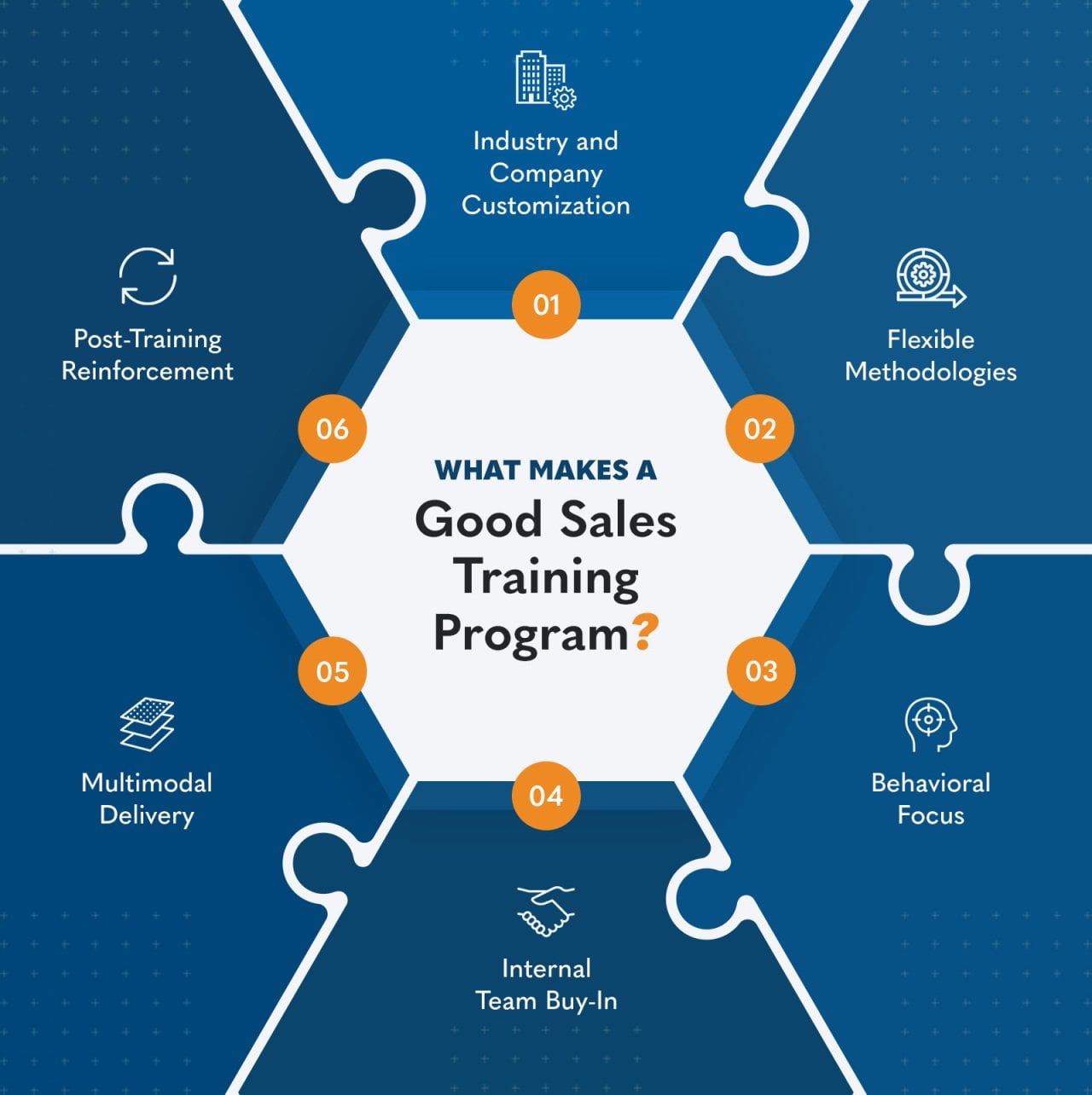
A good sales training program enables your sales team to negotiate better, close deals effectively and build lasting customer relationships. It goes beyond content delivery and ensures that team members can turn the new skills they learn into new habits. The program should also consist of the most relevant, updated materials and integrate with the latest technology, especially if you use customer relationship management (CRM) and sales enablement tools.
Here’s what to look for when buying a sales training program for your sales team.
1. Industry and Company Customization
Instead of having a generic curriculum, an ideal sales training program can be customized to your company’s goals and industry. It adapts to your sales processes, products and services, target market and competitive landscape. It also considers your compliance requirements and ethics to build customer trust and minimize legal risks. Apart from considering company goals, the program can assess each team member’s skills and determine their improvement areas by leveraging performance data.
2. Flexible Methodologies
Sales teams often use different methodologies to close a deal, depending on each customer’s situation. A good sales training program offers flexible methodologies to accommodate unique scenarios, while enabling your team to improve its processes and get ahead of the competition. Sales playbooks come with comprehensive guidelines on the scripts, sales processes, objection handling techniques and best practices.
A good sales training program also evolves with the industry changes and contains the most relevant sales strategies. The program may include courses on the use of different technologies, such as CRM systems and analytics software, to improve productivity and performance.
3. Behavioral Focus
Behavioral change makes the lessons stick. People tend to remember what they learn if they understand the “why” behind each lesson. A program that provides relatable industry examples can help team members visualize how to apply the lessons.
The ideal program should be holistic, teaching soft skills that enable stronger, more trusting client relationships, instead of just presenting tactical but transactional methods. These soft skills can include active listening, rapport building, negotiation and time management. Once your team improves these abilities, they can better prioritize tasks, manage their pipelines and meet quotas.
4. Internal Team Buy-In
While leadership buy-in is essential to implement training programs, your sales team’s perspective matters just as much. With an internal team buy-in, sales team members can be more open to new sales methods, increasing the likelihood of adopting the techniques in their daily practice. Sales representatives also often have busy schedules. A team buy-in will inform you of their openness to taking the training.
Additionally, outdated, irrelevant lessons can be cumbersome to get through, leading to unengaged team members and wasted resources. By ensuring your team is on board with the program, you’re increasing the chances of its completion.
5. Multimodal Delivery
Sales training programs often come in different modes of delivery:
- In-person training through classroom sessions, workshops and seminars
- Virtual training through webinars, online courses and interactive modules
Different formats cater to diverse learning styles, which makes training more effective. You can opt for stand-alone training solutions or combine modular solutions. For instance, you can combine self-paced learning modules with a traditional classroom setting, depending on your team members’ needs.
Whether you implement an in-person or online program, a good option incorporates role-playing and gamification formats that consider real-world scenarios. Gamification, in particular, increases training motivation and improves the acquisition of sales knowledge.
6. Post-Training Reinforcement
Sales training shouldn’t end with the initial lesson delivery. Your company must build on the momentum and ensure that your sales team puts the lessons they’ve learned into action. A robust coaching program helps with retention, as it teaches team leaders how to properly implement the new practices. Similar to the initial training, reinforcement programs should be engaging, interactive and easily integrated into the team’s daily routine.
Coaches are the key to helping your team achieve sustainable sales performance. They facilitate the team’s daily, weekly and monthly activities, and are in charge of the feedback loop that leads to behavioral change and long-term skill development. Manager engagement also affects team engagement, impacting productivity.
Benefits of Purchasing a Sales Training Program vs. Creating One In-House
While you can create your own training curriculum, starting from scratch comes with risks compared to purchasing a customizable training program. First, creating the training in-house takes up company resources. Instead of focusing on closing deals, your sales experts must invest time in creating the training. You also need to identify the differentiators between your top, middle and bottom performers, requiring data collection and statistical analysis. You must then translate this data into a practical, learnable methodology.
There’s no guarantee that this methodology will work in achieving your business goals. You also risk copyright infringement if your methodology ends up a mix of well-known methodologies, which may be patented or come with intellectual property rights. Opting for a trusted sales training program ensures you’re getting proven methods that work for your industry and specific use cases. You also leverage the expertise and experience of other professionals who have refined their methodologies over time, avoiding the need for trial and error of your own processes.
How to Evaluate a Sales Training Provider
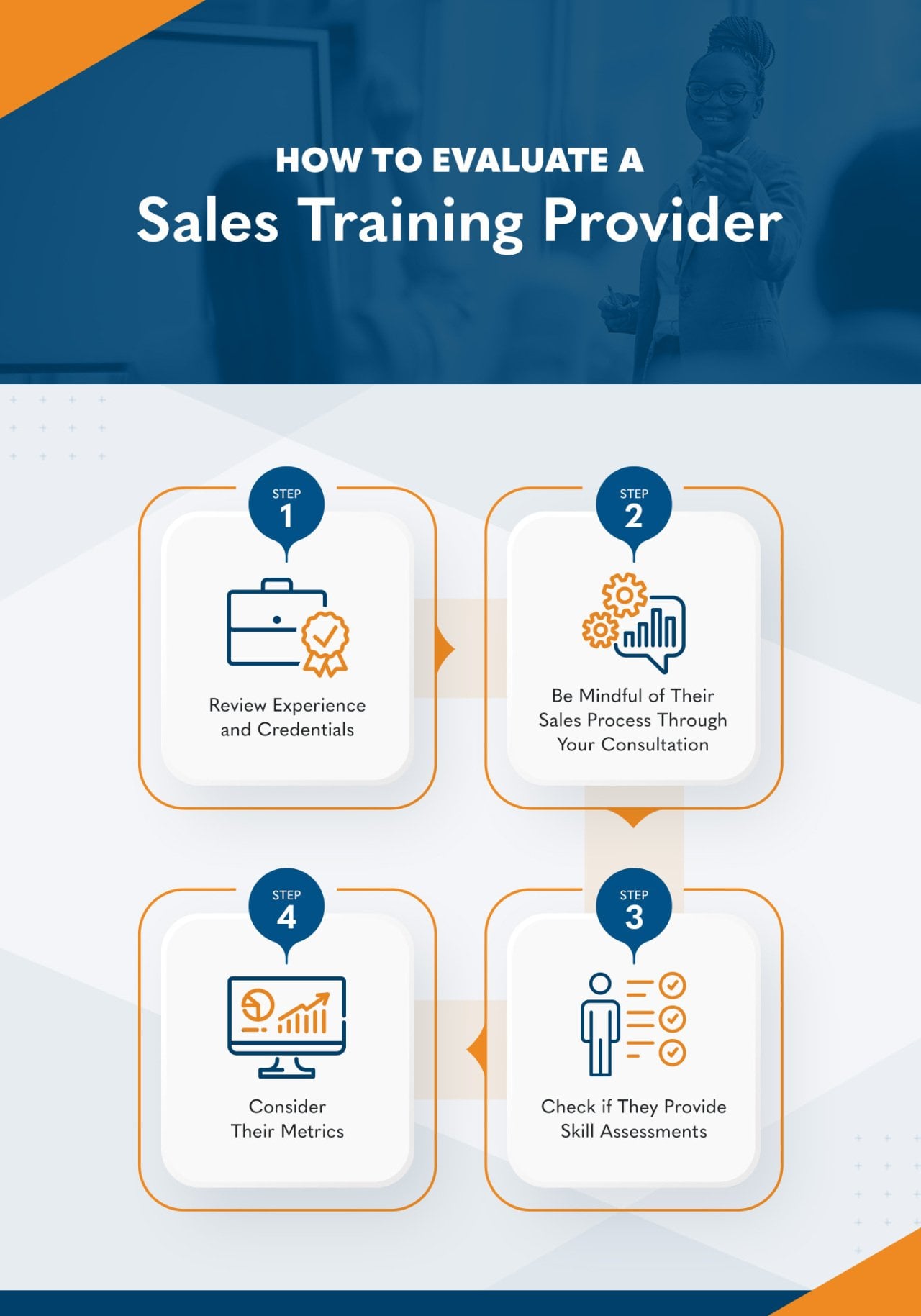
It’s one thing to note what a good program looks like, and another to understand who the capable providers are. All involved stakeholders must understand your business goals and strategies for an effective selection. When creating a short list of providers, consider these criteria.
1. Review Experience and Credentials
Review each provider’s credentials. They should have proven sales methodologies and in-depth experience in your specific industry and challenges. The field of sales enablement is also constantly evolving, so the provider must be able to adapt to the changes effectively. Business longevity is proof of their success. Their time in the business equates to the time they’ve had to perfect their concepts and strategies, showcasing sustainable results.
Facilitators with practical experience can provide engaging and relevant lessons, as well as real-world examples.
2. Be Mindful of Their Sales Process Through Your Consultation
The teacher should walk the talk. When they pitch you their training program, be mindful of their sales process. Were they knowledgeable and thorough? Consider asking these questions:
- What customization options do you have for our company?
- Which training formats can you provide?
- How can our team observe your sales training methodology before we commit?
- What sets you apart from other training providers?
- What industries do you typically work with?
- Can we contact other notable clients you’ve helped?
Ideally, you should see the sales methodology in action to understand if it’s a process that works for your team. Asking what sets providers apart from competitors also helps you identify industry specializations or expertise in specific sales challenges. Some differentiators may not even originally be on your radar, but can enhance your team’s effectiveness. Inquiring about notable clients through referrals should help you learn about other companies’ training experiences.
3. Check if They Provide Skill Assessments
Skill assessments enable providers to individualize training, catering to your team members’ specific strengths, weaknesses, career aspirations and learning styles. A one-size-fits-all approach can lead to ineffective training, which impacts team members’ engagement. Providers can perform the assessment through surveys, interviews and performance data analysis.
4. Consider Their Metrics
Metrics showcase the impact of the provider’s sales training program. Providers with metrics also position themselves to be serious about long-term behavioral change, instead of simply delivering content and quick fixes. Their metrics tell you if you’re making the right strategic investment. However, a reputable training partner will set realistic expectations regarding their program’s business impact instead of making lofty promises.
The metrics that matter most to each business can vary. You may consider:
- Win rates
- Quota attainment
- Employee engagement
- Customer satisfaction
- Productive time
- Profitability
- Training completion rates
Sales Training Technology to Consider
Different technologies improve your company’s sales training experience. When selecting a training program, look for tools that enable your preferred mode of delivery. Consider the following.
Learning Management Systems (LMS)
An LMS enables you to create, manage and monitor employee training, streamlining the entire learning process. It consists of a range of courses, interactive modules and other resources that cater to your team’s learning needs, based on their career stages. This platform lets team members access lessons at their own pace and timing, which can be more effective compared to traditional classroom environments.
Because the platform automatically tracks progress and automates reporting, you reduce potential administrative overhead. You’ll also easily track the effectiveness of the training programs by comparing your team’s training progress to your other metrics.
Reinforcement Tools
Reinforcement tools allow you to easily implement reinforcement and coaching practices. They make it easier for team members to engage and solidify behavioral changes that can increase successful deals. These tools can include platforms with worksheets, guides and recommendations that encourage team brainstorming sessions, one-on-one coaching and self-study activities.
AI Sales Tools
Sales tools leveraging artificial intelligence (AI) make the training process easier and more relevant for your team. Depending on your platform of choice, an AI sales tool can be your team’s 24/7 business sales coach. It enables continuous learning rather than a one-off training session after onboarding. The tool can be embedded in your existing software or training platform, enabling team members to ask plain-language questions and address their skill gaps.
Here’s how AI coaching tools function:
- You provide the AI platform with your sales methodologies and playbooks.
- The AI ingests the information to understand your business’s way of doing things.
- Your team interacts with AI to improve their skills before they apply what they have learned in practice.
- The AI provides feedback based on your training materials.
The integration with your platform and playbook ensures that the AI provides accurate and relevant feedback, according to your team members’ skill sets.
Frequently Asked Questions
Companies evaluating sales training programs also ask the following questions.
What Are the Different Types of Sales Training?
Sales training methods differ to accommodate various schedules, learning styles and career stages. The most common methods include:
- E-learning: E-learning refers to digital training methods, which can involve online tutorials, lectures or courses that team members can access at their own pace. They often use interactive quizzes to create an immersive and impactful learning experience.
- Role-playing sales training: Simulation training helps team members understand which scenarios apply to which methodologies. It gives them the chance to practice what they’ve learned without the potentially costly repercussions of making mistakes.
- Sales coaching: Sales coaching involves targeted guidance, where trainers consider each team member’s skills and goals. Facilitators create individualized training plans and provide personalized, actionable feedback.
- On-the-job training: On-the-job training involves learning through practical experience, as team members perform their regular duties.
- Informal training: Informal training is organic and occurs spontaneously, when a team member gains knowledge through their daily experiences, interactions and self-directed activities.
What Is the 2-2-2 Rule in Sales?
The 2-2-2 rule can have different interpretations. One interpretation is that it’s a rule of thumb for touchpoints with clients or customers. Here’s what it stands for:
- Two days: After two days of closing a deal or customer purchase, you can show gratitude and reinforce their decision to work with you.
- Two weeks: After two weeks, you can provide further value and keep the conversation going.
- Two months: After two months, you can reconnect and convince them of the next potential purchase.
What Is the 3-3-3 Rule in Sales?
One interpretation of the 3-3-3 rule helps you align your actions with your goal. Here’s what it means:
- Three outcomes: Determine your three goals for every sales interaction. For instance, you may want to aim for a discovery call, a pitch meeting or a follow-up conversation.
- Three questions: Before your interaction, think about the three questions that will help you understand your customer’s pain points. For instance, you might ask about their business challenges, roadblocks and metrics.
- Three next steps: Think about the three essential next steps after the conversation, which would keep the sales process moving. For instance, you might need to create a detailed proposal, provide a product demo or meet with additional stakeholders.
Elevate Your Team’s Sales Process With the Right Training Program
While you can create a sales training program in-house, the risks and costs often outweigh the benefits of a reputable program created by a trusted provider. Selecting a provider with experience and a proven track record can help you access a training program that’s worth the investment.
This story was produced by Janek Performance Group and reviewed and distributed by Stacker.


